Well, it's taken us longer to tie up all the loose ends associated with closing our Chattanooga store than we thought.Wednesday, February 3, 2010
Under Construction...
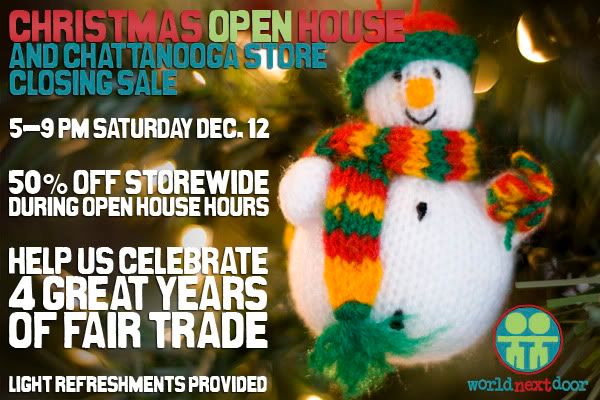
Well, it's taken us longer to tie up all the loose ends associated with closing our Chattanooga store than we thought.Greed is so last year
Thursday, December 10, 2009
Chattanooga Store Closing
Friday, November 13, 2009
Do We Have the Best Customers, or What?
Remember that Halloween chocolate giveaway we did? Well, people showed up, and I had a great time ooh-ing and ah-ing at lots of really cute and creative costumes. I thought the fun ended that night, but then, this week we received an adorable thank you note from two very polite trick-or-treaters.
Here it is:
Dear World Next Door,
Thank you for the delicious fair trade chocolate bats bars. We had fun tricker treating at your store. It makes us happy that you care about all the people in World. Your store is very special and one of our favorite stores.
Thinking of you and smiling,
(OK, they aren't really called that, but they are! Don't you agree?)
Wednesday, November 11, 2009
Back from Nepal!
Some school kids that later that night danced for us. I couldn't find my dad and I went outside and they had placed him in a chair in the middle of a crowd and were dancing for him. So fun!
We were in the mountains the second half of the trip- my dad was a part of a medical clinic. It was harvest time so everywhere we went we saw "walking haybales". People in Nepal can carry anything!
Monday, November 9, 2009
Chew on This
Looks like Nestle is in talks to make Kit-Kat fair trade...November 09 2009 - Discussions are underway between Nestle and Fairtrade for the confectioner’s Kit Kat brand to become Fairtrade-certified, reports claim.
Kit Kat is Britain’s best-selling chocolate bar, which would make it the biggest single Fairtrade-certified brand if talks are successful, according to dailymail.co.uk.
The Fairtrade logo is already appearing on rival brands as Fairtrade earlier this year certified Cadbury's Dairy Milk.
The Daily Mail reported that a spokeswoman for Nestle would only confirm that discussions had taken place with Fairtrade.
Kit Kat sales increased nearly 20 %this year following an advertising campaign with Girls Aloud.
The shift towards Fairtrade would be the latest in a string of efforts by the global food giant to improve its ethical credentials.
Last month Nestle announced its commitment to using only Certified Sustainable Palm Oil by 2015, the year when it said sufficient quantities were expected to be available.
It was also reported that the company is to spend 110 million Swiss francs ($109 million) on "sustainability initiatives" for the cocoa sector in the next decade, which includes providing millions of disease-resistant plantlets to cocoa producers to help boost yield.
Thursday, November 5, 2009
At the End of Slavery

The ways to get involved are myriad: host a screening of the film; write your Congressional representatives; simply tell a friend. IJM is billing next weekend, Nov. 14-15, as the Weekend to End Slavery. IJM president Gary Haugen will address filming parties across the U.S. at 8 pm Saturday night. Then on Sunday, churches across the country will encourage believers to get involved in the struggle for justice.
Honestly, this is not something you want to miss. (That sounds so trite--but I mean it from the bottom of my heart.)
Just in case my words aren't enough to convince you to check this out, here is what IJM says about the documentary:
Narrated by actor Danny Glover, At the End of Slavery: The Battle for Justice in our Time takes you inside the violent and ugly business of modern-day slavery — the buying and selling of human beings — from the brothels of the Philippines to the brick kilns of India.
Undercover footage and first-person testimony from former slaves and respected experts expose the enormity of the crime — but a remarkable strategy and the courage of today's abolitionists offer hope for a final end to this brutal trade.
Shot on location in the Philippines, India, Cambodia and the U.S., At the End of Slavery takes you to the frontlines of today's battle for justice and includes true stories of former slaves and undercover footage from police operations to rescue children from brothels. International Justice Mission's investigators, lawyers and social workers and their clients, along with other leading abolitionists and anti-trafficking experts, show that there is nothing inevitable about slavery. Law enforcement success in finding and rescuing victims, and prosecuting perpetrators, demonstrates the real possibility of an end to this trade.
Wednesday, November 4, 2009
Who Made Your Bag?
Well, this project is the answer to the ache I'm feeling to be closer to my "roots."
This project, MEND, is a clothing line sponsored by Invisible Children. The group was created to raise awareness about the invisible war in northern Uganda by sharing the personal stories of those involved.
"MEND is designed to seam a personal connection between products, their creators, and you. MEND is proof that what we wear can- and will- make a difference."
Watch this video: I promise you won't regret it!
Saturday, October 31, 2009
Turn It Upside Down
In honor of the day, we're doing our own version of the Reverse Trick or Treat thing we told you about earlier--handing out chocolate and information on fair trade chocolate to all comers in our store. I thought I'd share with all of you in Internet world what, exactly, we're sharing with folks, and give you a taste (bad pun, I can't help it) of the info we're sharing with everyone today.
I also thought you might be interested by this Creative Loafing story on a family who is celebrating Halloween with Reverse Trick or Treat for the first time this year.
I've posted the full article below. (OCD note: I am not responsible for the spelling errors in this story!)
Shannon Ward knows that what she buys for her family effects other people.That’s why she and her three kids are participating Reverse Trick or Treating this Halloween.
Seven year old Glynis, 11-year-old Nathan and 13-year-old Thomas will be handing out cards attached to a fair trade piece of chocolate to people in Ward’s father’s Huntersville neighborhood.
“I noticed that with Sameritan’s Purse, the group that sends the shoe boxes, a lot of them go to countries where a lot of chocolate and coffee comes from and I wondered how many of those families are farmers who are getting taken advantage of?” Ward said.
Global Exchange, a global human rights protection agency based out of San Francisco created this program. The organization has been around for over 20 years. 2009 marks the 3rd year of the Reverse Trick-or-Treating program.
This is the first year that the Ward family has had a chance to participate.
“Fair trade is really important to my family and we only buy fair trade chocolate and coffee. There is such an enormous amount of chocolate consumed around this time of year and Valentine’s Day that I just wanted to let people know about it. I think if more people knew about what fair trade is and what it means when they don’t buy fair trade that it would sway them to make different decisions or at least think about the decisions that they’re making.”
So, what is fair trade?
It is a social movement to get higher payment to the farmers in developing countries that produce things like coffee, chocolate and sugar to name a few items.
Ward said that she and her family try to expose as many people to fair trade items. Whenever there is a chance to share things at her kids’ school, The Community School of Davidson, she makes a handcrafted hot chocolate made with fair trade ingredients to get the conversation rolling.
Where does Ward find fair trade coffee and chocolate. The coffee, she said, is easy.
“You can find fair trade coffee any where. Even Wal-Mart and Food Lion sell it now,” she said.
But the chocolate, you have to search for. Here’s a hint — it ain’t Hershey’s. Ward said stores like Earth Fare and Healthy Home Market have fair trade chocolate.
She also said she buys some fair trade chocolate online at Sweet Earth Organic Chocolate.
Ward said she hopes that more people will start paying attention to fair trade and think about the choices they make.
Friday, October 30, 2009
This is not so much an event as it is a simple freebie.Shop at World Next Door on Halloween dressed in your Halloween costume, and you'll receive a free bar of fair trade chocolate!
Thursday, October 29, 2009
End Human Trafficking

According to VOA News, Richard Danzieger, head of the Global Counter Trafficking Program at IOM, says that, although problems like poverty and misogyny contribute to human trafficking, it is the consumer's demand for unreasonably inexpensive labor and goods that drives the trade.
He [Danziger] says the campaign aims to change consumer behavior through the use of soft power, not hard power. "We are not asking people to boycott a particular brand or boycott a particular super market or chain store. We are simply asking people to find out what lies behind the products they buy. We are asking people to buy responsibly," he said.
The International Labor Organization estimates 12.3 million people are in forced or bonded labor and sexual servitude around the world.
Danziger says stories about human trafficking usually focus on women and girls used for sexual exploitation. But he says both men and women are trafficked for labor exploitation.
He says there have been large increases in the last five years in the trafficking of men and boys to work in the agricultural, construction, fishing and domestic service sector. "We estimate, based on some ILO (International Labor Organization) figures that in industrialized countries there are over 100,000 trafficked migrant workers. So, severely exploited migrant workers. If they were paid their back wages, the wages they are due, it could come to something like $2.5 billion. So, we are talking about large sums. Throughout the world, there is an estimate by the ILO of what we call stolen wages of almost $20 billion," he said.
Tuesday, October 27, 2009
Buy Responsibly
Here's what blogger Amanda had to say after seeing the video: "Our demand for cheaper products is one of the big drivers behind human trafficking in a number of industries, from the food we eat to the clothes we wear to the houses we live in. In fact, slavery in the production of consumer goods is so pervasive, I can guarantee that both you and I own at least a handful of items made by slaves; we have eaten food grown, harvested, or produced by slaves. So if we are going to get serious about ending human trafficking, we need to take the Buy Responsibly campaign's message to heart and make an effort to purge our buying habits of slave-made goods. So does that mean you should boycott every industry that has used slavery? No. For one, it's not a very sustainable lifestyle choice. Information about which products have been tainted by slavery is often outdated or inaccurate. Plus, the use of human trafficking in supply chains is so prolific, you'd be starving and naked before long, and very few people are willing to live like that voluntarily. While boycotts have changed and can improve corporate behaviour, boycotting may put non-trafficked workers' jobs at risk, making some workers worse off. Before considering boycotting a certain product, think about who will profit from and who will be affected by the boycott. If you do boycott, make specific demands and agree to end the boycott when those demands are met. Another effective way to buy more responsibly is to buy products from companies that have a commitment to fair labor practices. When given a choice between a Fair Trade item and another one, go with the Fair Trade option. Choose products from companies with reputations for treating workers fairly. Tell companies that the rights of workers is an important consideration in your choice of products. These may seem like very small steps, but as companies see that fair labor standards are important to consumers, they will meet that demand like they now meet our demand for low prices."
Saturday, October 24, 2009
New, New, New!

Thursday, October 15, 2009
Free Coffee Cupping

Come join us this Saturday, Oct. 17, from 2-4 p.m. as we host a free coffee cupping (like a wine tasting, but with coffee) at our store. Guests from Pasha Coffee and Tea will be on hand to guide us through the experience. Pasha is the only coffeehouse in Chattanooga to serve only fair trade and organic coffee and tea, so their staff have lots of experience and wisdom to share.
We at World Next Door will also be sharing a bit about how Fair Trade principles benefit small coffee farmers in developing countries.
You don't want to miss this! We look forward to seeing you Saturday.
Wednesday, October 14, 2009
Back to Nepal!
Well, I never dreamed that I would be going back to Nepal in the same year. But I leave Friday! Nathan and I continue to be amazed at the number of connections we have with this country. Not only through fair trade organizations that we work with, but also through other friends in town. This trip though, Nathan will be unable to come as there is much work to be done at World Next Door! Stop by and say hello because he might be kinda lonely :-). And at the end of the month we'll be participating in GPS' annual Robin Hood event, so Nathan and Beth (our amazing, awesome, "we could not do this without her!" blog writer and assistant manager) will be quite busy. My dad will be going to Nepal this time, and I'm excited about showing him a little more of how fair trade works.
If you'll remember with me back to late April and May, Nathan and I were in India and Nepal visiting fair trade groups. We also started a relationship with an organization that is rescuing girls from being trafficked at the border of Nepal and India. You can read about how that works here. We're selling their banana fiber products in the shop right now and are very excited about the customer response. Sometimes when you purchase things, you think they will sell, but you never really know until they go on the shelves. These products are beautifully made, and everytime I look at them, I can't help but think of the women and girls in Nepal who are being empowered through the skills that they have learned at the half-way house. Not only have they been rescued/prevented from a life of prostitution, but they are being empowered to go back into their communities to help other girls learn how to read, write, sew, etc. It is very exciting! You can see some of these products on our website. Scroll down to the bottom and look for the banana fiber hats and scarves.
Half of my time in Nepal will be spent at the half-way house, hopefully talking about products and how we can partner with them better as a store. The other half will be in the mountains where my dad and other Nepali doctors will be doing a medical clinic. We fly into a village in the mountains, and then have to hike 3 or 4 hours- complete with horses carrying our medical supplies!- to another village where the clinic will be. I don't have any medical experience but I can play with kids, run medicines to people, and be an extra set of hands. I will try to post some blog entries while I'm gone but probably will not have as much access to a computer as Nathan and I did last time. I'm sure to come back with lots of stories though!
So, see you in a couple of weeks with (I hope) 3 or 4 duffel bags full of product!
Friday, October 9, 2009
Why Bananas Matter

It's special for two reasons. One, bananas are the top selling item in British grocery - the trade is worth nearly £600m per year. In terms of value, only petrol and lottery tickets outsell bananas in supermarkets. This means that banana prices have become a key weathervane, like the prices of traditional staples such as bread and milk, of supermarket prices in general. People notice banana prices. If shoppers think you have cheap bananas, they may think your prices are lower across the board. Secondly, and more importantly, in real terms these are probably the lowest prices for bananas that have ever been charged.
It very much depends on who you are. If you're a banana consumer (and most of us are), your weekly banana bill has been cut by half in less than a year. There's a recession on, and every little helps. Bring on the banana fritters and the banana splits. On the other hand, cutting the price in half, and perhaps saving you 50p per week, might represent disaster for thousands of farmers in the developing world, who grow bananas - and barely make a living doing so - and have seen the prices they receive steadily drop over the last decade. These are tough times for the public in Britain, but they are desperate times for poor farmers in countries such as Costa Rica and Ecuador.
Because banana production is the archetypal example of how agriculture in the developing world can perpetuate social injustice and trap people in poverty. Bananas are the most popular fruit in the world - shoppers spend more than £10bn on them annually, and they are the world's fourth most important crop after rice, wheat and maize.
Banana production is consequently an operation on a gigantic industrial scale and is dominated by just five huge companies, Chiquita (formerly United Fruit), Dole, Del Monte, Noboa and Fyffes, which control 80 per cent of the global trade between them.
They grow bananas in vast monoculture plantations in tropical countries, employing tens of thousands of workers. But, according to the Fairtrade Foundation, many of the workers are paid pittance wages insufficient to provide for their families - less than £1 per day in some cases - for working long hours in very difficult conditions, and often prevented from forming trade unions to protect their rights and improve their working lives.
The situation of small independent banana producers is also precarious, and in the Windward Islands in the Caribbean, which were once the mainstay of Britain's banana supplies, 20,000 out of 25,000 banana farmers have gone out of production since 1992.
Every time the price of bananas in the rich countries falls, there is pressure on the big producers to cut the wages and benefits of their workers to maintain profits, and often impossible pressure on independents to match the low prices. Between 2002 and 2008, supermarket price wars saw the price of loose bananas in the UK slashed by 41 per cent, but Asda's latest price cut is something again.
Because it takes banana prices to a historically low level, almost certainly below the cost of growing them, picking them and shipping them across the world. The Fairtrade Foundation, which now gives its accreditation to a quarter of the bananas sold in Britain, has been tracking banana retail prices in the UK since 2000 (when they were at 90p per kilo) and the baseline of the graphic it has used was set at 65p, as no-one ever expected prices to fall below that. Now Asda has cut them to 46p - way off the graph.
"We've never seen this," Harriet Lamb, the Fair Trade Federation's executive director, said yesterday."It never even occurred to us we would see prices go this low. This is the lowest level since records began after World War Two, the lowest level in absolute terms ever. It is completely unsustainable. It is ludicrous. It is just Asda playing games. It is also completely pointless, as their rivals will all follow suit. The point is what the long-term impact will be for farmers and workers in the banana industry. It is clearly impossible to cut prices by this much without making the deepest cut of all - to producers' livelihoods."
Tuesday, October 6, 2009
Bundle Up

So cute! We sell these in both children and adult sizes. Talk about a fun Halloween costume.
This poncho and the hat below are made out of banana fiber in Nepal. Approximately one billion tons of banana fiber are thrown away every year; clothes like these put what was formerly waste material to good use. In addition, impoverished people can benefit from making and selling clothes and accessories (i.e. the ones you see pictured below!) made of the banana fiber that is plentiful in their local environment.


Be sure to check out these products in our online store.
Saturday, October 3, 2009
News of the Day
Check this out:Friday, October 2, 2009
La Paz De Dios and Fair Trade

There's a great organization here in Chattanooga with whom we've had the privilege of working quite frequently over the last couple years. They're known as La Paz de Dios, and they provide all kinds of support services to the local Latino community. As we understand it, their primary aim is to empower Latinos to better and more fruitfully integrate into Chattanooga, both socially and economically. And that's good for them, and for Chattanooga.

- A Latino community overseas, attacking poverty and helping to chip away at the incentive to emigrate;
- The work of La Paz, helping to engage Chattanooga's Latino community to become more integrated and productive in our area, and;
- Us, a locally-owned and operated small business.